 |
The BME Story |
|
Bill Miller Engineering’s roots in the hard-core race engine parts business go
back a generation.
In 1970, fresh out of the military, Bill Miller worked as
Warehouse Manager at National Speed and Marine in Los Angeles. This speed shop
campaigned a Top Fuel Dragster. In his early years in the automotive
aftermarket, not only did Bill Miller get to know the sales and distribution end
of the business but he learned about drag racing by crewing a Top Fuel car.
|
 |
|
This is the car that began
Bill Miller's 20+ years of blown-fuel drag racing, the first BME Top Fuel
Dragster. Miller and his car are in front of his second factory in
Torrance, California in early-1984. The engine was a Fontana-Chevrolet and
the driver was Mike Woodard: Image: Hib Halverson/Bill Miller collection |
A
few years later, Miller worked at the old Ansen Automotive Engineering where he
became familiar with Ansen’s aluminum connecting rod. The Ansen rod was a
leading-edge design but had limited market success because the manufacturing was
in Japan. In the early’ '70s, this arrangement didn’t work well because lead
times were months, sometimes even a year, and the company could not respond to
market changes which occurred in shorter time-spans. Ansen eventually moved
production back to the United States.
About 1974, Ansen changed hands and was renamed American Racing. The new owner
was interested mainly in the wheel business. Bill recognized the Ansen rod’s
advanced design and that it outperformed other aluminum rods. More
importantly, he was convinced of its potential for market success now
that production was on American soil.
These ideas in mind, and influenced by his experiences with the National Speed
and Marine Top Fuel car, Miller decided to go into business making aluminum
connecting rods for drag racing. Miller went to his new employer with an offer
to buy the connecting rod business and finance the purchase through a split of
the profits.
BME: Open for Business
|
In June, 1975, Bill Miller Engineering, Limited began business in a tiny, 1200
sq. ft. factory in Long Beach, California. BME’s first years were a grueling
experience. Bill Miller spent days working at American Racing as Quality Control
Manager and six-to-eight hours each night on his rod business.
The initial tasks were to sell the inventory of Japanese-made rods on hand and
set up the BME manufacturing operation.
Early-on, Miller found most of the Japanese tooling didn’t work very well.
New machines had to be ordered and new tooling had to be built.
|

The second BME T/F car, with Russ Collins
doing the driving, at the NHRA World Finals in the late-80s. Image: Bill
Miller Collection |
The learning curve was steep because, while understanding the sales and
marketing end of the race engine parts business, Miller was new to the
manufacturing side. Bill became a self-taught machinist, toolmaker and
manufacturing engineer on a crash basis. Through determination, seven-day weeks
and four hours of sleep a night, Bill Miller Engineering slowly got on its feet.
|

. |
Through the mid-to-late
’70s, BME Forged Aluminum Connecting Rods became well-known in drag racing
circles with racers like Bill “Grumpy” Jenkins, Bob Glidden and Warren Johnson
becoming quick converts and staunch supporters. By the end of the decade, Miller
had paid off his debt to American Racing and, in the drag racing world, the BME
brand had become synonymous with high performance, outstanding quality,
excellent service and great value. Part of this success comes from the company’s
mission statement: “Bill Miller Engineering is dedicated to designing,
developing, and manufacturing the finest aluminum rods in the industry. Our
commitment to the racer is total.”
By 1978, the tiny Long Beach
facility had become too small. BME moved up the San Diego freeway a few miles to
larger quarters in Torrance. The first half of the 1980s brought more success.
The company thrived now that it had more room. BME Rods continued to take the
sport of drag racing by storm. In 1981, Bill Miller Engineering fielded the
first of several of its own Top Fuel Dragsters, a 240-inch, Don Long chassis
with a blown-fuel, Fontana/Chevrolet for power. Mike Woodard, Bill Miller’s
racing associate from his prior drag race effort, a Top Gas Dragster, was the
driver of the new, BME race car. |
|
Left to right are: Russ Collins, Dale Armstrong (at the time he was
Kenny Bernstein's Crew Chief) and Bill Miller. Armstrong was the first
big-name blown-fuel racer to use BME Rods. In the 20-years since Dale
Armstrong switched to BME, many other drag racers have followed his
lead. Image: Bill Miller Collection |
|
BME Pistons
In 1982, in a major expansion of its
racing engine parts business, Bill Miller Engineering purchased the old Forged
True Piston company. Forged True was started by hot rodding pioneer,
Art Sparks, at the end of World War II. Sparks was the inventor of the
manufacturing process used to make a forged aluminum piston. When war
production ceased in 1945, all of a sudden, Sparks’ friend,
aircraft manufacturer Donald Douglas, had a lot of unused forging presses in his aircraft plant at Santa Monica,
California. Art Sparks made a deal with Douglas to use those presses to make
forged pistons for the Offenhauser, four-cylinder, Indianapolis race engine.
Forged True went on to become a major brand in the premium racing piston field
during the late-40s, 50s and 60s. Not only did Sparks have his own successful
business, but TRW paid him a lucrative royalty to use his forging process in its
volume-market, forged pistons which were sold as both O.E. and aftermarket. Art
Sparks retired a very wealthy man.
During the 1970s, Forged
True Pistons changed hands several times. Successive corporate owners, more
interested in quick profits than good products and service, ran the once famous
and respected name into the ground.
Upon Forged
True’s acquisition in 1982, Bill Miller had another herculean task ahead of him.
Sales had tanked and the company’s reputation was in shambles. First, the name
was changed to “BME Forged Racing Pistons”.
|
|
|
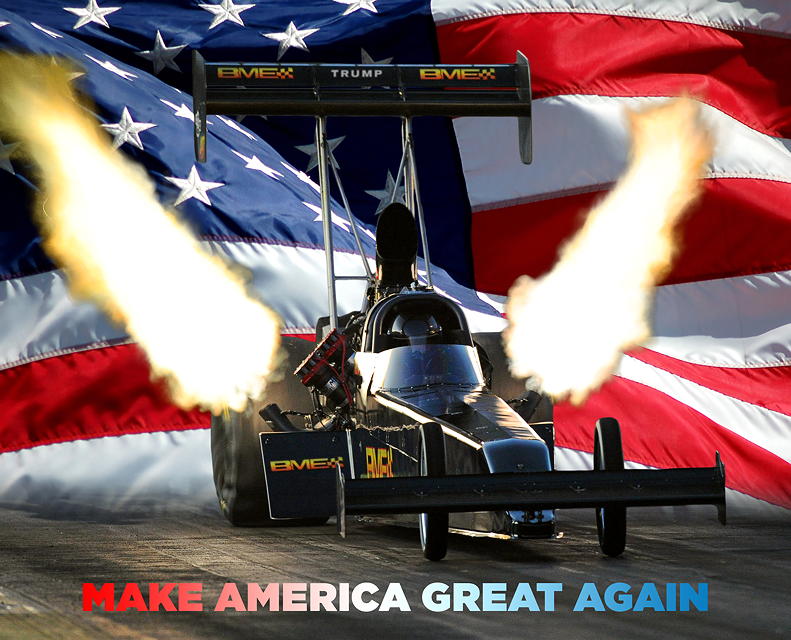
In 1981, Bill Miller Engineering begin to
campaign Top Fuel dragsters. There have been several over
the years. The current BME Top Fueler, sponsored by BME, machine tool maker,
Okuma, and the Red Line Synthetic Oil Corporation, is a Brad Anderson/Hemi
powered, 300 in. Don Long-built race car. Bill Miller has always taken a
hands on approach to his race car, in this case, programming the BME
Dragster's on board data recording system. |
|
|
 |

At today's BME, quality and teamwork are two key themes. At left, a BME
Team Member runs a quality control check on a Sprint Cup piston using a
coordinate measuring machine and, above, Bill Miller discusses quality and
manufacturing process with another Team Member who works on aluminum rods. |
|
Then, Bill applied the same business plan and
commitment to excellence that made his Aluminum Connecting Rod a drag racing
benchmark. A key marketing decision concentrated the business mainly on
the piston needs of hard-core drag racers. Later, that would change but, for the
time being, BME needed to narrow its focus to free-up time and resources to
solve other problems. Next, stringent quality control processes were instituted.
Finally, the same labor relations that bred dedication and enthusiasm in the
employees on the connecting rod side of the business were applied to the new,
piston operation.
|
Three years later, as the BME Piston
situation began to improve and with the increasing difficulty of spreading his
management team between two distant locations in the Los Angeles area, Bill
Miller combined the rod and piston operations in a new, even larger factory in
Harbor City, California.
During the remainder of the 1980s and the
early-’90s, Bill Miller and the hardworking team BME employees, brought the
piston business to a point where its reputation equaled that once enjoyed by
Forged True, then they exceeded it. In addition, the company continued its quest
for excellence with the BME Forged Aluminum Rod. More team members were hired.
New machinery, including the first of BME’s computer numeric-control (CNC)
machining centers, was installed allowing additional increases in quality and
production rates for all BME products.
|
 |
In 1992, after
eight years of solid growth, Bill Miller Engineering, once again struggled for
working space and began yet another search for more spacious quarters. This
time, though, it went farther than just up the freeway. In the early-’90s, the
State of California’s increasingly hostile business climate forced an
out-of-state relocation. In 1993, BME selected Carson City, Nevada as its new
home. Once again, a move to larger quarters enhanced BME’s growth and its
products. Buoyed by a less restrictive regulatory environment, a skilled labor
force and a pleasant climate, Bill Miller Engineering continued to thrive.
Buoyed by
his company's growth in its first few years in Carson City, Bill Miller made a
significant investment which would result in a major improvement in the BME's
mainstay product, the Forged Aluminum Rod.
In 1996,
after a comprehensive research and development program, Bill Miller Engineering
introduced rods made of a new, highly-advanced, aerospace-derived, aluminum
alloy. This new type of aluminum provides an average, 15% increase in tensile
and yield strength along with equal or better elongation and other mechanical
qualities with, most importantly, no increase in weight and no significant
increase in price.
Revitalized by a less restrictive regulatory environment, a
skilled labor force and a pleasant climate, Bill Miller Engineering continued to
thrive.
|
|
Bill Miller Engineering's 1992 move to Carson City, Nevada had it
constructing this factory near the Carson City airport. |
Buoyed by
his company's growth in its first few years in Carson City, Bill Miller made a
significant investment which would result in a major improvement in the BME's
mainstay product, the Forged Aluminum Rod.
In 1996,
after a comprehensive research and development program, Bill Miller Engineering
introduced rods made of a new, highly-advanced, aerospace-derived, aluminum
alloy. This new type of aluminum provides an average, 15% increase in tensile
and yield strength along with equal or better elongation and other mechanical
qualities with, most importantly, no increase in weight and no significant
increase in price.
The "new"
Bill Miller Engineering Forged Aluminum Connecting Rods design saw rapid success
in the market and, since then, sales have continued to be strong. A dozen years
after its introduction, the revised Connecting Rod continues to be Bill Miller
Engineering's core product and continues to dominate the market for aluminum
connecting rods.
BME Moves to
NASCAR
By 1995, the Bill Miller Engineering Forged Racing Piston was so highly
regarded that Hendrick Motorsports, the top team in NASCAR Winston Cup (now
called Sprint Cup) Racing, switched to BME Pistons. When news got out of which
piston Winston Cup Champion, Jeff Gordon was using, other teams jumped on the
band wagon. Over the last dozen years, BME racing pistons have been used by all
the top NASCAR teams racing Chevrolets, Pontiacs or Dodges. In addition to
four-time Champion, Gordon; seven-time Winston Cup Champion, the late Dale
Earnhardt; 2000 Champion Bobby Labonte; 2002 Daytona 500 Winner, Ward Burton,
and 2005/2002 Sprint Cup Champion, 1999 Rookie of the Year and 2007 Brickyard
400 winner Tony Stewart, all ran Bill Miller Engineering Pistons.
|
BME Builds
Blowers
In 1996, Bill Miller Engineering introduced the Gibson/Miller
Supercharger. Designed cooperatively by Bill Miller and aerodynamicist Tim
Gibson, the Gibson/Miller Supercharger is intended for blown-fuel and
blown-alcohol drag race applications and other situations were a high-flow,
high-boost, Roots-type supercharger with outstanding durability is required. The
Gibson/Miller Supercharger was quickly embraced by top competitors in nitro
class drag racing for its outstanding quality and high performance. The
improved, Gibson/Miller Mark II debuted in January, 2009 and continues as the
most efficient, reliable and durable supercharger available to nitro class
racers. |

This view of the BME factory floor shows the piston and connecting rod
manufacturing lines.
|
|

In the southwest end of the BME's plant are the lines which make
Gibson/Miller Supercharger parts along with BME Pistons and Wrist Pins. |
BME Parts are
the Best Money Can Buy
Bill Miller Engineering occupies a 20,000 sq. ft. facility
just north of the Carson City Airport. A state-of-the-art manufacturing facility
is divided into three sections, one for each of BME¹s major products, Rods,
Pistons, Wrist Pins and Superchargers. A clean, well-lit factory area is loaded
with the latest in machine tool technology including Okuma and Haas CNC
Machining Centers and Ikegai CNC Turning Centers. Located in the same building
are warehousing, executive offices and the BME Top Fuel Dragster race team
facility. |
Bill Miller Engineering is the consummate American business success story. It
began a generation ago with one man’s idea how high-quality connecting rods for drag race engines
should be made. Today, BME thrives with scores of loyal, quality-driven
employees teaming up to manufacture the best aluminum connecting rods, forged
racing pistons and wrist pins that money can buy.
|
 |
|
Bill Miller and wife Virgie are supported by dozens of
dedicated team members are what make BME products great. |
|
|
|
|
Copyright © 2009 Bill Miller Engineering
|
|
|